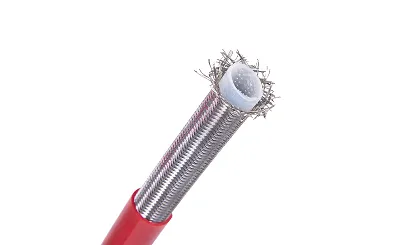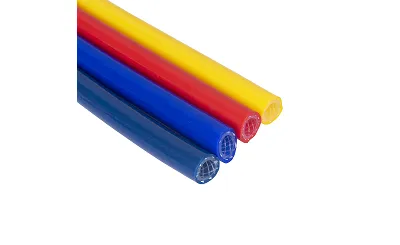
The manufacturing of silicone tubing primarily involves several stages: inner tube extrusion, braiding, outer tube extrusion, and vulcanization. The inner tube extrusion process requires precise control of the wall thickness-typically maintained between 1 and 2 millimeters-to prevent braiding failures caused by insufficient structural support during the subsequent braiding stage. Furthermore, the inner tube can be customized to meet specific requirements, such as high-temperature resistance, flame retardancy, or specific color specifications.
During the braiding stage, tubing braided with standard fiber threads can withstand pressures ranging from 12 to 38 kilograms, or even higher. For applications requiring significantly higher pressures or negative pressure (vacuum) resistance, high-strength materials-such as nylon fishing line-may be employed. The braiding process is executed by a program-controlled braiding head, ensuring a precise and uniform braiding pattern. During the outer tube extrusion stage, particular attention must be paid to eliminating any air that may become entrapped between the braided layer and the inner tube; issues such as air bubbles and surface irregularities can be effectively resolved by appropriately increasing the wall thickness of the outer tube.